The FFF (Formula for Failure)

I was what some people would say, one of those lucky kids in school. I enjoyed reading and taking tests. I liked learning new things and tackling a problem. And I usually could figure out what needed to be done to get a good grade, do it, and then pass the test. School came fairly easy to me.

I liked getting good grades. I was proud of them. I wasn’t very good at sports and was fairly shy when I was younger, but I soon realized I could get attention and praise for my academic achievements. The teachers liked my grades, my parents liked my grades, I could get a shiny trophy at the end of the school year for my grades – it wasn’t long before I equated good grades with success. 

As I got older, I started to think of my classes as something similar to an algebraic equation. What formula did I need to use to get a good grade? It went something like this:

 X + Y = A+100 Success!!! 

How could I perform in this class? What teacher liked for me to ask a lot of questions? What teacher wanted a quiet student who never bothered him? Who wanted me to write long, detailed essays to get an A and who preferred brief, precise essays? I could always figure it out. 

College became even more of a challenge to prove my success. But I loved it. I loved the fact that I had the secret formula to winning . X + Y= A+ 100 Success!!! Every. Single. Time. (Hi Enneagram 3s – Yes, I’m one of you.)

When I graduated from college and started my teaching career, I was still working that formula. In my mind, my principal and supervisors took on the role of my teachers. What did I need to do to get a good grade from them? Simple – pass my observations with flying colors. Show growth in my students. Figure out what equaled an A+ 100 Success!!! and get to work to achieve it. Wow, I was good at this. 

Then I had a son. A beautiful, perfect baby that I adored more than anything else in the world. He was a gift from the day he was born. 

So, of course, I put my formula to work on him:

X + Y = happy, healthy baby (Which still equated to an A+ 100 Success!!! in my mind). 

This is a little embarrassing for me to admit, but I would take the baby book What To Expect The First Year and cheerfully check off my son’s accomplishments each month. I’m not talking about just reading the list and mentally checking things off – I’m talking about taking a pencil to the developmental lists in the book and literally marking each developmental stage off the list. Crawling by 9 months? Check. Saying at least 5 words by 12 months? Check. Eating a variety of foods by 15 months? Check. 

Good Mom + Total Devotion + Sacrifice + Doing Everything Right = Happy, Healthy Baby/A+ 100 Success!!!!

And don’t even get me started about our well check-up visits to the pediatrician. That was my report card. The pediatrician was my teacher and he was giving me the good grades. “He looks great” or “He’s very healthy”, or for bonus points – “He’s thriving” made me feel like I had the formula figured out again. I was getting an A+ 100 Success!!! in motherhood. 

Until one day . . . that awful day when our pediatrician told me our son had Type 1 Diabetes and he was very sick. 

That day a big, red F was scrawled across my life. 

For the first time, I had failed to get the good grade. And what was even worse was that because of my failure, my bad grade, my son would be suffering. He would bear the burden of my F – for the rest of his life.  

My formula had not worked. I was a failure. And it took me a long, long time to recover from it. 

If you have never felt like a failure, if you have never had a red F marked on a page in your life, then bless your heart, you probably haven’t lived to see 40 yet. Failure in life will happen, but here’s what I learned through my first F: We ALL have had failures. Some may have stemmed from our own bad decisions, some may have come out of nowhere. Some may happen in school, in our marriages, in our careers, in our family. And it hurts. Especially when we have a formula that we thought would prevent or protect us from those failures. 

The beautiful part of my failure, though, was that over time I quit judging myself so harshly and criticized others even less. It’s hard to remark on someone else’s scarlet letter when you have one of your own pinned to your chest. 

So slowly, over lots of tears and pleas for help and the silent treatment I gave God, I began to understand that I had been using the wrong formula my whole life. There was no X + Y = A+ 100 Success!!! 

There was only one formula to use and Jesus had given it to us thousands of years ago:

Love God + Love Others = Love

It’s a backwards sort of equation that makes no sense at first. It shows us how to give and not get. It demands that we be last and not first. It stands us on our head sometimes, then pushes and pulls us, and leaves us with more questions than answers. And it’s the only formula that will ever lead us to true success, which really doesn’t look like success at all. It just looks like love. 

I should have followed it years ago . . . 

I wish I could tell you that I have learned my lesson and I don’t strive for those As in life anymore, but I still struggle with it. I fight the urge to compare, to judge others, to work my old formula to achieve success. But now I know that there is no pass and fail in life. There is only one formula, dear friends, and that is love.  

And we all can get an A in that.
Share This:

The Summer of Elvis

Dear Friends,

With summer coming to a close, many of you have asked me about our Summer of Elvis. (For those of you who are new, I am a little strange in the fact that I like to name my summers. If you haven’t read about The Summer of No, you can read it here.) I’ve had a few weeks to think about our Summer of Elvis and to really contemplate what I gained from it. I’ve thought about why Elvis became so important to my little family, how sometimes we can glean meaning from the oddest things, and what specifically the Summer of Elvis has taught me.

Listen carefully, because I’m going to share with you the important things I learned from our summer.

Are you ready?

You might want to grab a pencil and notepad to write this down.

This summer, The Summer of Elvis, I learned this . . .

Nothing.

Nada.

Not one darn thing.

I haven’t got anything important to tell you about what I took away from The Summer of Elvis because frankly, I didn’t take away anything from it.

It was just really fun. And that’s it.

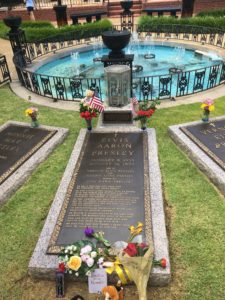
Scott, I, and the kids visited Graceland at the end of May and we were all touched and surprised at the life of Elvis. We learned little things about his life and growing up in the South, something we could all relate to. We visited his gravesite which was quiet and beautiful. Then we rolled our windows down and blasted Elvis music all the way home. We were hooked.

This summer we listened to all the Elvis songs we could find. We helped Hugh search music shops for old Elvis records. We listened to podcasts about Elvis (my favorite is Malcom Gladwell’s podcast called Analysis, Parapraxis, Elvis). Hugh learned to play “Suspicious Minds” on the piano and we would all sing along as he played – Hugh taking the lead with Amelia on back-up vocals. We got Elvis books from the library. We researched how Elvis died, where Priscilla is now, and who is in charge of his vast fortune.

There were late night discussions with friends around our dining room table about whether Elvis was the real deal or if he had stolen his style from less famous R&B singers from the South. The kids learned that their grandparents had once been crazy teenage Elvis fans who had actually gotten to attend some of his concerts. We learned about young Elvis, movie star Elvis, and not-so-healthy chubby Elvis (but like Amelia says, “We don’t talk about fat Elvis”). We soon realized that Elvis is something you can discuss with almost anyone. Elvis was connecting us to all sorts of people in a lot of different ways.

So maybe there is a lesson in The Summer of Elvis after all. Maybe the lesson is that there are times when we just need to have some fun. Maybe we need to step off the ladder, put on an Elvis record, and sing as loud as we can. Maybe it’s ok to do something just for the joy of it all – with no other reason than that.

I’m sure there have been times in your life, as there has been in mine, when there isn’t much fun happening. When Hugh was first diagnosed with Type 1 Diabetes and we were in the hospital with him, I couldn’t imagine ever having fun again. I thought our life was going to be a nightmare of shots and constant worry and numbers that I didn’t even understand. There wasn’t any laughter and there was definitely no fun.

But you know what? That was over 5 years ago and we have had so much fun since then. I guess I could have said no to all the fun – I could have used Diabetes as an excuse to never laugh, never play, never indulge in the joy of life. But, literally, where is the fun in that?????

Life is a lot of hard things, but it’s also a lot of fun. There are times to work hard, there are times that are painful, there are times when we just can’t laugh, but there are also times when the fun returns. I promise it will. You just have to open yourself up to it.

And if you’re kind of stuck right now, maybe in a place where there’s not a lot of joy and not a lot of fun, may I suggest putting on an Elvis record or downloading his greatest hits? Close the door and practice your best Elvis dance moves, sing until you are out of breath, and whenever you leave the room, announce that Elvis has left the building. It’s not magic, but it is a start.

After all, Elvis would want you to have a little fun.                   

Thank you, thank you very much.

Share This:

The Lamkin Home

Several years ago, Scott and I bought a house not too far from here. When we first moved in, we noticed an old doorbell outside the front doors, with a small, rectangular nameplate above it. In neatly typed letters was the last name “Lamkin”. We soon discovered that the man who built our home in the early 1960s was named Mr. Lamkin, and he was a gifted architect in his time. We also discovered that when people would ask us what house we moved into in the neighborhood, we could simply say, “The Lamkin Home” and they would instantly know which house we were talking about.
People told us stories of when the house was first built – how Mr. Lamkin used bricks from an old school to build the house and the extensive courtyards. We were told that he and Mrs. Lamkin loved to entertain and would throw huge parties for family and friends. The dining room was long enough to fit a table for 20 people, and the conversations would flow for hours around that table. Sometimes guests lingered well after midnight, enjoying good food and good friends. The pool was built close to the house, and we’ve been told it was the first non-rectangular pool in the neighborhood – a feature Mr. Lamkin insisted upon. Doors slid open wide from every room in the house, allowing the outside to mingle with the inside. There were fountains in the courtyards, a fish pond in the back, and if memories are correct, a huge LSU mural decorated one entire wall of the kitchen. There were lots of parties, lots of laughter, lots of friends and lots of memories made in this house. This house was built to be loved, and this house was built to be shared.
Sadly, Mr. Lamkin died a few years after building his home. Mrs. Lamkin lingered on for many more years, but fell into ill health in her older age. The house declined with Mrs. Lamkin, and after her death, was sold several times. Through the years the fountains in the courtyards stopped working, the fish pond dried up, the brick outer wall crumbled in places, and the long dining room table disappeared. When we bought the home, it had been stripped of many original mirrors, light fixtures, drapery, and hardware. But the nameplate remained outside the front doors. We have never even considered removing it. This was the Lamkin Home, we were just borrowing it for a little while.
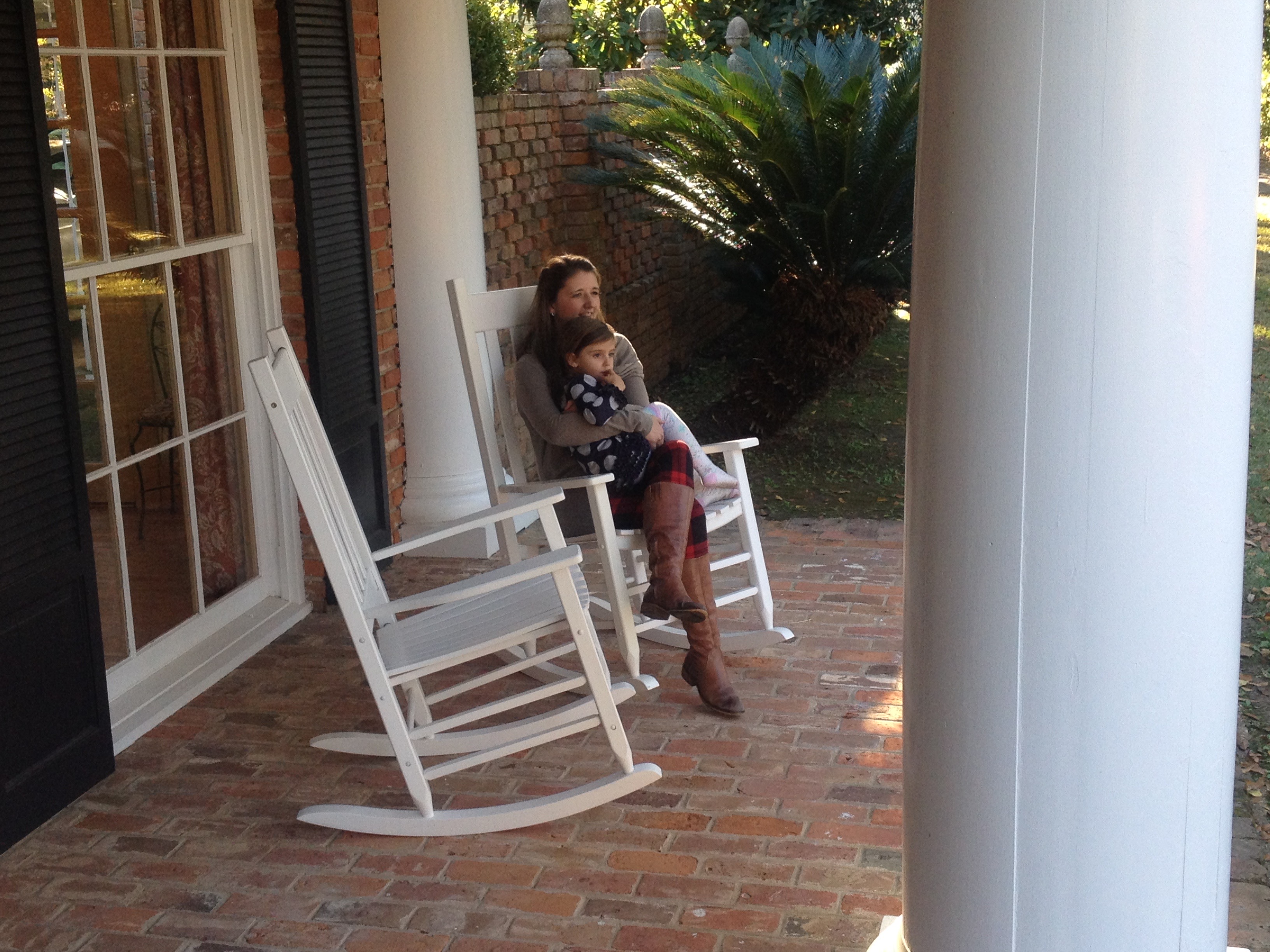
In the years since we have moved in, we have tried to restore a little bit of the life that was taken from the house. We’ve repaired brick walls, cleaned outside courtyards, hung pictures, painted ceilings. We placed rocking chairs on the front porch again, planted a garden, got a dog. Our summers are filled with family and friends swimming in the uniquely un-rectangular pool, kids running in and out of the open doors, and late nights around the fire pit. We linger over shared meals in the dining room, laughter and noise fill the house once more.
And do you know something? If the sun hits the water on the pool just right, and it’s a certain time of day, and if I squint my eyes just a little, I can see Mr. Lamkin outside, walking around the yard – talking to his guests and enjoying the beautiful home he created. I like to think that Mr. Lamkin is looking down on us, watching us as we make his house a home. And I like to think that he is happy.
It may sound a little silly, but I think that if our church had a doorbell right outside our front doors, the nameplate would say “God” on it. And we would know this is not our house, but that we are just borrowing it for a little while. Over the years bricks might have crumbled around some exterior walls, windows may have rotted in places, water may have leaked in. We’ve had our share of building problems and it’s been a long, extensive process to begin repairing those problems. But slowly, we are giving our old building life again. Soon there will be light and laughter and children on the third floor, where once it was dark and silent. We will linger once more around dining tables with good food and good friends downstairs in the fellowship hall. We will fill this space with love and friendship, and we will open the doors wide for anyone who wants to join us. This house was built to be loved and this house was built to be shared.
There were architects at this church, once, who dreamed of and designed this space. There were people – moms and dads, students, children – who wanted to create a place where all were welcome. They sacrificed for not just themselves, but for those of us who would come many years later, seeking the same love and friendship that can only be found in God’s house. Their memories linger on in the walls of this sacred space. We hear stories of weddings, births, funerals, parties, banquets, and musicals. We have never even considered erasing those memories. They tell us of a God who loves, who endures, who delights in his people.
And if the sun hits the rose window just right, and it’s the right time of day, and we squint our eyes just a little, we might be able to see God – walking around, talking to his guests and enjoying the beautiful home he created. I like to think that He is looking down on us now, watching us as we make his house a home. And I like to think that He is happy.

Share This: